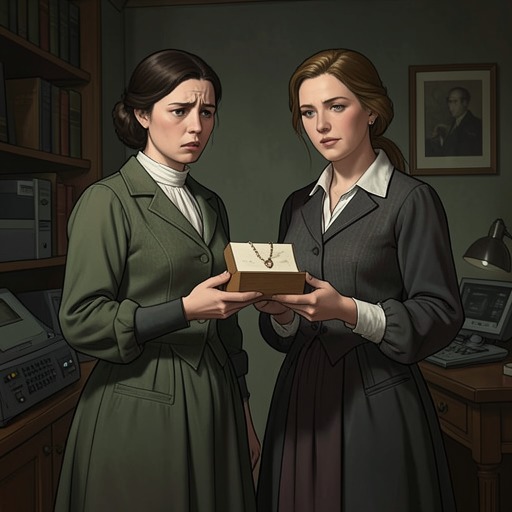
Charlotte Blacklock assumes Letitia Blacklock’s identity
A Murder Is AnnouncedCharlotte Blacklock’s assumption of Letitia Blacklock’s identity begins with a death that reverses the sisters’ expected futures. When the healthy Letitia dies of influenza that develops into pneumonia, Charlotte loses both her sister and the inheritance they had anticipated from Belle Goedler. She responds by making the dead sister’s identity her own: Charlotte is buried under Letitia’s name, and the surviving Charlotte returns to England as Letitia. The deception turns an impending inheritance into the motive and framework for the murder plot.
The inheritance and the reversal
Randall Goedler left his fortune in trust for his wife, Belle, for her lifetime, with the estate to pass absolutely to Letitia after Belle’s death. Letitia explained that the money would not now mean much to her, but the order of deaths remained decisive: when Inspector Craddock asked what would happen if Letitia died before Belle, she said she believed the fortune would go to the legal offspring of Randall’s only sister, Sonia. The inheritance therefore depended not simply on family connection but on who survived whom and on the identities of the eligible heirs.
The possibility of an alternative succession had entered the arrangement through Letitia herself. She had reminded Randall of Sonia when he told her about his will, then proposed that Sonia’s children, Pip and Emma, be named if Letitia died first. Randall had rejected the idea of Sonia inheriting directly because he despised her husband, Dmitri Stamfordis, whom he regarded as a crook; he reluctantly accepted the children as substitutes. Years later, Letitia could say that she and Randall had heard nothing of Sonia or her children. Their uncertain whereabouts made the succession clause a real but distant contingency, while Belle’s approaching death made Letitia’s inheritance seem near.
Bereavement becomes impersonation
Charlotte and Letitia had heard that Belle could not live long and could imagine the fortune as the basis for the life they would share. For Charlotte, the prospect carried particular weight: it promised release from years of being regarded with pity or repulsion and the chance to travel, keep a house and grounds, acquire clothes and jewels, and enjoy plays and concerts. Letitia’s death, coming just as Belle’s inheritance seemed close, destroyed both that imagined future and Charlotte’s relationship with her sister. The account presents Charlotte as perhaps resentful that Letitia died at precisely that moment, although the resentment is offered as an interpretation rather than a stated confession.
Charlotte’s reasoning collapses the distinction between the two sisters and between what was intended for Letitia and what Charlotte wanted for herself. The money, she could tell herself, was meant to come to Letitia within months; she regarded herself and Letitia as one. The impersonation thus rests on more than a wish to escape poverty or obtain wealth: in her distorted moral accounting, taking Letitia’s place makes an inheritance that would have benefited both sisters available to the sister left alive.
How the deception was made possible
The switch depended on how little the two women had been distinguished by outsiders. They had appeared as elderly, well-bred Englishwomen, dressed much the same and strongly resembling one another. The possibility that people might not reliably tell one sister from the other made the substitution conceivable at the moment of death. Charlotte was buried under Charlotte’s name, while the woman who had been Charlotte took up Letitia’s identity and came to England.
The new identity also gave Charlotte a change in social bearing. In her former role she had played second fiddle; as Letitia she assumed the authority and command associated with her sister. Their temperaments were not described as wholly different, but the account stresses a moral difference between them. The impersonation therefore transfers not only a name but also the public authority attached to that name.
Charlotte took practical precautions to protect the fraud. She bought a house in an area of England unknown to her, avoiding a few people in her native Cumberland town who might have recognized her; she had already lived there as a recluse. She also had to avoid Belle, who knew Letitia well enough to make impersonation impossible. The change in handwriting was explainable through the arthritic condition of her hands, and Charlotte’s limited acquaintance with people who had known her before reduced the risk of exposure.
Recognition by Letitia’s former acquaintances posed a different problem from recognition of Charlotte. They might notice that Letitia had changed over ten years, but that change would not necessarily make them suspect an imposture. Charlotte could account for her failure to recognize people by citing short-sightedness, while her knowledge of Letitia’s London life, acquaintances, and haunts let her supply personal details. Letitia’s letters gave her a further means of reference: she could mention shared incidents or ask after mutual friends. The one recognition she truly feared was being identified as Charlotte.
Exposure and significance
The deception’s apparent stability depended on people accepting resemblance, altered appearance, and imperfect recollection as ordinary features of aging and separation. Its weak point was the original identity Charlotte had to keep concealed. The inheritance supplied the motive, but the sisters’ resemblance, Charlotte’s knowledge of Letitia’s life, and the scarcity of people who knew Charlotte together supplied the means.
The arrangement also creates the central irony of the inheritance. Letitia had tried to provide for Sonia’s children if she herself predeceased Belle, yet Charlotte’s substitution makes the question of who is alive, who has died, and who is legally entitled to the fortune inseparable from the false identity. By the time the investigation closes in on Charlotte, the clues have become dangerous to her; Inspector Craddock fears that Jane Marple is already on the track and that she may be in immediate danger. The identity switch is therefore both the concealed foundation of Charlotte’s assumed life and the secret whose discovery threatens to bring it to an end.